
How to choose MV insulation technology
Every medium-voltage project eventually asks the same question: air, gas, or solid?
AIS, GIS and solid-insulated switchgear all do the same job at 12–40.5 kV — they switch load, clear faults and isolate circuits. What separates them is how they insulate, how much floor they take, how they behave in a hostile environment, and whether they can still be sold into the European Union after 2026.
This guide compares the three families on the criteria that actually decide projects, and ends with a selection matrix and the datasheet clauses that keep the specification honest.
Key takeaways
- AIS is the cheapest and the easiest to maintain, and it needs the most space and the cleanest air.
- GIS wins where floor area is expensive or the environment is hostile — humidity, salt, dust, altitude.
- Solid-insulated sits between the two and is SF6-free by construction, not by option.
- At medium voltage, the interrupter is almost always vacuum in all three families. The gas or solid is insulation, not interruption.
- Since 2026, SF6 regulation — not price — decides a growing share of European projects.
1. The three families, in one page
| AIS | GIS | Solid-insulated | |
| Insulation | Air at atmospheric pressure | SF6 (or SF6-free gas) | Epoxy / solid dielectric |
| Interruption | Vacuum | Vacuum | Vacuum |
| Typical voltage | 12–40.5 kV | 12–145 kV | 12–40.5 kV |
| Enclosure | Metal-clad, ventilated | Sealed for life | Sealed for life |
| Access to live parts | Compartmentalised, serviceable | None | None |
| Typical position | Industrial plants, utility distribution, renewables | Urban substations, data centres, offshore | Compact substations, containerised plants, coastal sites |
Two clarifications that save a lot of confusion in tender documents.
GIS does not mean SF6 interruption. At medium voltage, a GIS panel is almost always a vacuum interrupter inside an SF6-filled tank. The gas insulates; the vacuum interrupts. When someone asks for “SF6-free GIS”, they are asking for a different insulating gas or a solid dielectric — the interrupter does not change.
“Solid-insulated” is a construction, not a brand. It means the busbars and interrupters are cast in epoxy or wrapped in a shielded solid dielectric, with earthed screens on the outside. It is also called shielded solid dielectric switchgear, and it is frequently confused with a sealed RMU. An RMU is a function — two to four ways, load-break switching, often with fuses. Solid insulation is a technology that an RMU may or may not use.
2. Insulation and interruption are two separate questions
Specifications go wrong when the two get merged.
Insulation decides the size of the enclosure. SF6 has roughly three times the dielectric strength of air at the same pressure, which is why a GIS panel is a fraction of the volume of an AIS panel. Solid epoxy sits between the two and can be shaped around the conductor, so it packages almost as tightly as gas.
Interruption decides the wear mechanism. Vacuum interrupters dominate 12–40.5 kV in every family: they are sealed, need no gas handling, and their contact erosion is measured in tens of thousands of operations at rated current.
That leaves the practical differences in environmental behaviour:
- Air-insulated equipment breathes. Humidity, salt fog, dust and corrosive gases reach the insulation surfaces, and pollution level (IEC 60815) has to be designed for.
- Gas-insulated equipment is sealed, so the outside environment stops at the tank wall. That is the real reason GIS is specified on coastal and offshore projects — not compactness.
- Solid-insulated equipment is also sealed, but the dielectric is bonded to the conductor. Partial discharge control in the factory is the whole game; a void in the epoxy will not announce itself until year eight.
If a specification says “GIS” but the site is a clean, air-conditioned industrial hall, the premium is being paid for nothing. If it says “AIS” on a coastal site with 95% humidity, the maintenance bill is being deferred, not avoided.
3. Footprint and civil works
Panel width is the number everyone compares, and it is the least useful one. What matters is the room the panel needs around it.
| AIS | GIS | Solid-insulated | |
| Panel width (36 kV) | 0.8–1.0 m | 0.6–0.8 m | 0.7–0.9 m |
| Rear access | 1.2–1.5 m cable compartment | Not required | Not required |
| Front operation | 1.5–2.0 m | 1.2–1.5 m | 1.2–1.5 m |
| Room height | 3.5–4.5 m | 2.5–3.0 m | 2.5–3.0 m |
| Cable termination | Accessible, conventional | Sealed, elbow or T-body | Sealed, elbow or T-body |
| Typical room for 10 panels | 60–80 m² | 25–35 m² | 30–40 m² |
For a 10-panel 36 kV lineup, the difference between AIS and GIS is roughly 40 m² of floor and one metre of ceiling height. In an industrial plant that is worth very little. In an urban substation, a data centre or a containerised plant, 40 m² can outweigh the entire equipment cost difference.
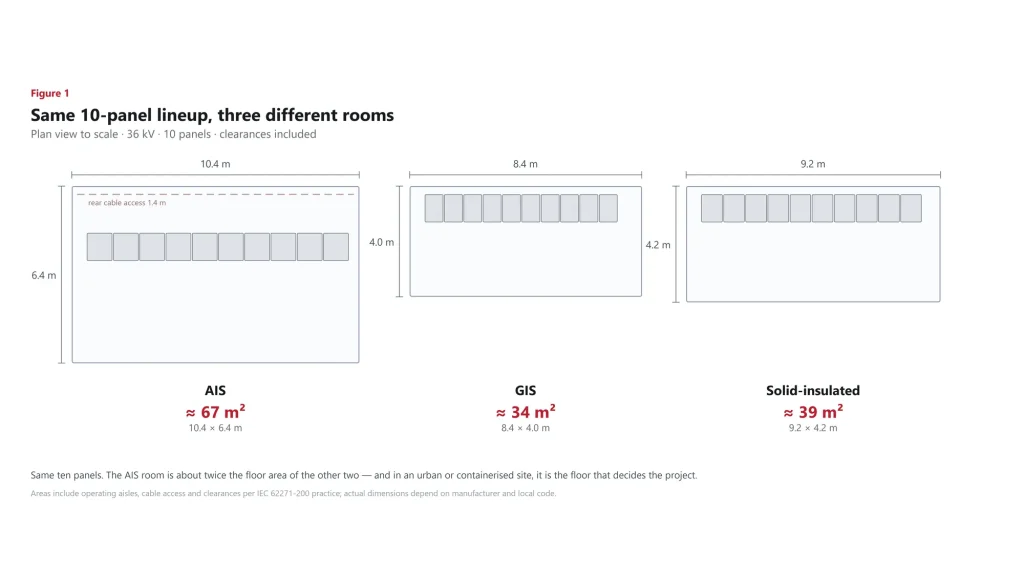
The civil works follow the same logic. AIS needs a ventilated room with cable trenches and a defined pollution level; GIS needs a clean, dry room and a foundation that respects the tank’s tolerances; solid-insulated equipment needs a dry room and clean cable termination work, because the interfaces are sealed and unforgiving.
4. SF6 and the regulation that now decides tenders
SF6 is the most potent greenhouse gas used in switchgear, with a global warming potential of roughly 24,000 times CO2. A single kilogram is equivalent to the annual emissions of several cars, which is why regulators have stopped treating it as a technical detail.
The EU’s F-gas Regulation (EU) 2024/573 phases SF6 out of new medium-voltage switchgear, with the first milestone applying to the ≤24 kV class from the start of 2026, later dates for higher voltages, and derogations for specific applications. The regulation also brings leak checks, certification of personnel, labelling and end-of-life recovery obligations — costs that land on the operator, not the manufacturer.
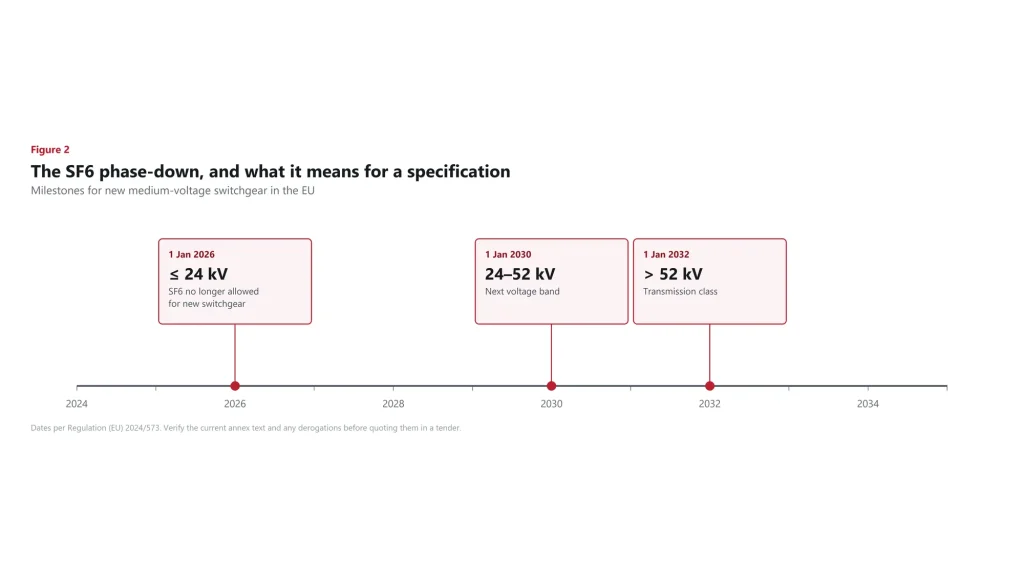
Three practical consequences for a 2026 specification:
For EU-bound projects, the safe default is SF6-free. Either specify solid insulation or an SF6-free gas, or document why a derogation applies. Arriving at commissioning with an SF6 GIS and no compliance path is now a schedule risk, not a paperwork problem.
For other markets, the pressure is commercial rather than legal. Utilities in Japan, California and parts of the Middle East already write SF6 limits or reporting requirements into their specifications, and export customers increasingly ask for a GWP declaration alongside the type test report.
For the equipment itself, ask for the leak rate, the gas mass, the GWP value used and the recovery procedure. “Sealed for life” is not a compliance answer; it is a maintenance statement.
One warning about SF6-free gas alternatives: they are not automatically zero-impact. Fluoronitrile and fluoroketone mixtures still have a GWP, just a much lower one, and they still fall under F-gas reporting in some jurisdictions. If the tender says “SF6-free”, check whether it means “no SF6” or “no fluorinated gas”.
5. Capex and lifecycle cost
The purchase price ranking is stable and predictable. The 20-year ranking is not.
| AIS | GIS | Solid-insulated | |
| Equipment cost (index) | 1.0 | 1.8–2.5 | 1.3–1.7 |
| Floor area | High | Low | Low |
| Civil works | Medium | Medium (clean room) | Low–medium |
| Routine maintenance | 12–24 months | 5 years+ | 5 years+ |
| Condition monitoring | Optional | Often built in | Optional |
| End-of-life | Scrap value | Gas recovery required | Standard recycling |
| Lead time | 8–12 weeks | 14–20 weeks | 10–16 weeks |
Run the numbers on a 20-year horizon and the ranking often flips. AIS saves 40–60% on equipment and loses it on floor area, cable access and maintenance visits. GIS costs the most up front and asks for almost nothing afterwards — which is exactly why it dominates urban and offshore work, where a maintenance visit costs more than the panel.
The honest way to compare is to price four things together: equipment, the room, the maintenance visits over 20 years, and the cost of an outage. Most spreadsheets include the first and forget the other three.
6. Selection matrix
| Scenario | AIS | GIS | Solid | Why |
| Urban indoor substation | ○ | ● | ● | Floor area dominates |
| Industrial plant, clean hall | ● | ○ | ○ | Cheapest sufficient answer |
| Coastal / high humidity | ○ | ● | ● | Sealed insulation, no pollution path |
| High altitude (>2,000 m) | ○ | ● | ● | Air clearance and correction factors |
| Desert, high dust | ○ | ● | ● | Sealed tanks, no surface contamination |
| Containerised / prefabricated | ○ | ● | ● | Volume and transport envelope |
| Data centre MV distribution | ○ | ● | ● | Availability and zero maintenance |
| Renewable collector | ● | ○ | ● | Cost per bay, outdoor enclosures |
| Seismic zone | ○ | ● | ● | Lower centre of gravity, rigid tanks |
- = preferred ○ = workable
Read the matrix as a starting point, not an answer. Two rows override everything else: the local grid code, and the customer’s maintenance capability. A utility with a trained SF6 team and a spare-gas contract will run GIS happily for thirty years. A plant with two electricians and no gas handling equipment should not.
7. What to write into the datasheet
The clauses that separate a comparable tender from three incomparable ones:
- Rated voltage and insulation level— 36 kV, 170 kV lightning impulse, or the local equivalent.
- Busbar and feeder current— calculated per bay, with the future margin stated separately.
- Short-circuit rating— 25 kA or 31.5 kA, with duration (1 s or 3 s).
- Internal arc classification— IAC class, current and duration, plus the access side (front, rear, lateral).
- Partition and continuity— partition class (PM or PI), loss of service continuity (LSC1, LSC2, LSC2B).
- Earthing switch class— E1 or E2, and whether it is capable of making short-circuit.
- IP rating and pollution level— IP4X inside, IP54 for outdoor enclosures, pollution level per IEC 60815.
- Ambient, altitude, seismic— including the correction factors the manufacturer must apply.
- SF6 declaration— gas mass, GWP, leak rate, recovery procedure, or an SF6-free statement.
- Partial discharge limits— the test voltage and the pC limit for solid-insulated equipment.
- Type test reports— which laboratory, which standard, which date.
- Dimensions and cable termination— panel width, depth, height, and the termination type offered.
8. Five mistakes that cost money
- Buying GIS for compactness alone.If the room is cheap and the air is clean, AIS does the same job for half the price.
- Comparing panel width instead of room area.Rear access and ceiling height decide the building, and the building usually costs more than the switchgear.
- Specifying SF6 GIS for an EU project in 2026 without a derogation.The equipment may be perfectly good and still not placeable on the market.
- Leaving out internal arc classification.It changes the room, the ducting and the price, and it cannot be retrofitted.
- Assuming solid-insulated means maintenance-free at any rating.At the top of the range, heat dissipation and PD behaviour still need an engineering answer.
FAQ
Is GIS always SF6?
No. At medium voltage, GIS usually means a vacuum interrupter in an SF6 tank, but SF6-free gas and solid-insulated designs are marketed under the same compact-enclosure logic. Ask what the insulating medium is, not what the enclosure is called.
Can AIS be installed outdoors?
Yes, in a weatherproof enclosure or a kiosk, but then you are paying for the enclosure and losing the maintenance accessibility that made AIS cheap. At that point, compare it with a compact substation.
Which is best for a coastal site?
GIS or solid-insulated. The deciding factor is not corrosion of the enclosure — it is that sealed insulation keeps salt and humidity away from the dielectric surfaces entirely.
What does IAC mean?
Internal arc classification: the tested ability of the switchgear to contain an internal arc without the enclosure opening, and to direct the hot gases to a defined area. It is expressed as class, current and duration, plus which sides are protected.
Is SF6-free more expensive?
Today, typically 10–25% more than an equivalent SF6 design, and the gap is narrowing as volume grows. On an EU project after 2026, compare it against the cost of a derogation, not against the SF6 price.
Specify once, for twenty years
The three families are not better or worse than each other. They are answers to different questions: how much floor do you have, what is in the air, and what will you be allowed to install in five years.
If you are comparing options for a 12–40.5 kV project, send us the single-line diagram, the room dimensions and the site conditions. We will return a like-for-like comparison across the three technologies, including the SF6 position for your market.